
The Power of Breathing
August 18, 2026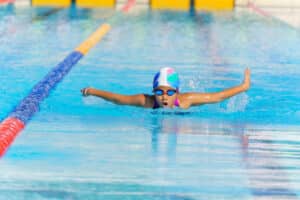 Learning to swim can be hard, especially when the concept of breath control is at the forefront of effective swimming. Breath control refers to one’s ability to manage inhaling and exhaling to improve efficient lung functioning, calming the nervous system, and supporting performance (such as in singing, speaking, and of course swimming.
As simple as it may seem, deep breathing is incredibly useful. Deep breathing aids the body through many functions such as calming and regulating the nervous system, helping your body cope with stress, ease panic and worry, and of course brings more oxygen to the body (and brain). Deep clear breaths can equate to a smooth functioning brain and body!
For these reasons, breath control in swimming is extremely important, as we just discussed its ability to calm your nerves and body in general. For most new swimmers, the hardest part of breathing is not necessarily the physical act of breathing, it’s the feeling and the act of being under water. Being submerged can naturally cause a person to become tense or even anxious. When a swimmer feels nervous they may resort to holding their breath, lifting their head, rushing their movements, or begin taking irregular breaths. Due to the uncomfortable nature, panic and anxiety make swimming even more difficult.
Controlled breathing helps to break this cycle. When swimmers are able to learn to slowly exhale underwater and calmly turn their head to inhale, breathing becomes much more predictable, easing the swimmer’s body and mind. Instead of feeling like they’re fighting for their next breath, they begin to understand that another breath will come and this is just a cycle within the stroke. This sense of control aids in building confidence in the water. Over time, swimmers will be able to focus more on relaxing and moving efficiently through the water instead of worrying where their next breath will come from.
That was a lot of information! But don’t worry, for beginners learning to breathe in the water may be awkward and scary at first and this is completely normal. With patience, repetition, and a little confidence, breathing can become a natural part of your stroke. Learning to control your breath has everything to do with learning how to control your body in the water. When breathing becomes smooth and consistent, the stroke will become calmer, smoother, and much more enjoyable for the swimmer.
Here is one technique any one can use to begin improving their breath control:
BOX BREATHING/SQUARE BREATHING
Square breathing, also known as box breathing, is a technique for deep breathing, which has shown to help relax the nervous system. In this technique our goal is to take even breaths with isometric holds. Just like a square, our breaths and holds will be equivalent on all sides. The goal of this technique is to breathe in for 4 seconds, hold for 4 seconds, breathe out for 4 seconds, hold for 4 seconds. If you find 4 seconds to be a little challenging and don’t find yourself struggling instead of relaxing try switching to 2 or 3 seconds instead!